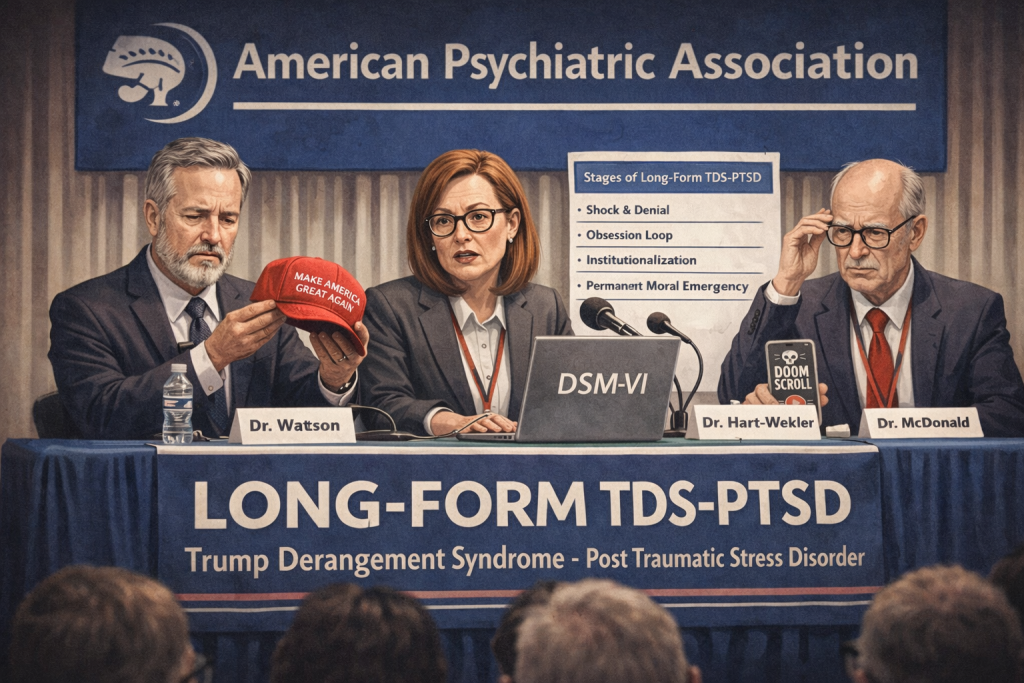
WASHINGTON, D.C. — In what it called “a necessary update for the modern age,” the American Psychiatric Association announced that the forthcoming DSM-VI will include a brand-new psychosis category: Long-Form Trump Derangement Syndrome–Post Traumatic Stress Disorder (LF-TDS-PTSD).
The condition, long observed but previously relegated to cable-news panels and faculty lounges, has now been formally codified after what the APA described as “overwhelming anecdotal evidence and zero contradictory peer review.”
“We realized this wasn’t situational distress,” said DSM-VI editor Dr. Penelope Hart-Wexler. “It’s chronic, identity-binding, and self-reinforcing. In short: it met all our criteria.”
DSM-VI CLASSIFICATION
Code: 309.45-LF
Disorder Type: Persistent Political Psychosis
Duration: Indefinite
Trigger Stimuli: Red hats, court rulings, pickup trucks, silence
Reality Testing: Optional
The DSM-VI entry describes LF-TDS-PTSD as “a prolonged maladaptive fixation on a political figure no longer in office, accompanied by exaggerated threat perception, compulsive moral signaling, and recurring narrative collapse.”
Core Diagnostic Criteria
Involuntary Trump references during unrelated discussions (e.g., sourdough, parking meters, bird flu)
Persistent belief that democracy is currently ending—again
Startle response to election maps, Florida, or unsupervised memes
Use of the phrase “This is unprecedented” more than twice daily
Inability to define fascism, but extreme confidence in spotting it everywhere
Chronic doom-scrolling “for mental health”
Associated Behaviors
Clinicians note frequent comorbidities, including:
Narrative Dissonance Disorder
Cable-News Dependency Syndrome
Credential Inflation Response
Group-Affirmation Echo Fixation
Patients often insist they are “just concerned citizens,” while exhibiting elevated cortisol levels and spontaneous weeping over Supreme Court news alerts.
Stages of Disease Progression
Stage I: Shock & Denial
“This isn’t who we are.”
Stage II: Obsession Loop
8–10 hours of “staying informed.”
Stage III: Institutionalization
Enrollment in DEI boards, activist NGOs, or academic task forces.
Stage IV: Permanent Moral Emergency
Everything is existential. Groceries. Sports. Weather.
Treatment & Prognosis
The APA confirmed that traditional therapies—CBT, mindfulness, exposure to opposing viewpoints—have shown “negligible success.”
Experimental DSM-VI-approved interventions include:
Gradual reduction of cable-news intake
Supervised exposure to normal conversations
Temporary reality immersion
Outdoor activity without narration
“There is no known cure,” the DSM-VI entry concludes. “However, patients report temporary relief when reassured that they are the sane ones.”
Clinical Note
The APA emphasized that LF-TDS-PTSD should not be confused with political disagreement, civic engagement, or actual trauma.
“This is grief,” Dr. Hart-Wexler clarified. “Not for a person—but for a narrative that stopped working.”


